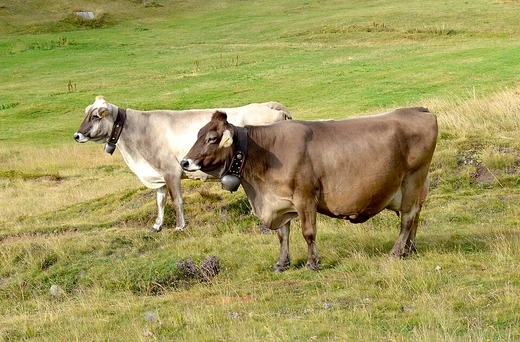
Hereford cattle
British beef breed with distinctive white face.

The Hereford is a British breed of beef cattle originating from Herefordshire in the West Midlands of England. It was developed through selective breeding from the mid-eighteenth century, beginning some decades before the noted work of Robert Bakewell, and has since spread to many countries worldwide.
- breed
- Hereford cattle
- origin
- Herefordshire, West Midlands, England
- type
- Beef cattle
- developed
- Mid-18th century
- nationality
- British
- known_for
- White face characteristic, global distribution
Lore & Background
Until the 18th century, the cattle of Herefordshire resembled other southern English cattle, being wholly red with a white switch, similar to the modern North Devon and Sussex breeds. In the late 18th and early 19th centuries, other cattle (mainly Shorthorns) were used to create a new type of draught and beef cattle which at first varied in colour, from yellow to grey and light brown, with varying amounts of white. By the end of the 18th century, the white face characteristic was well established, and the modern colour became fixed during the 19th century.
Reader's Guide
Its spread began in the late 18th and early 19th centuries, reaching Ireland, the United States, Australia, and Argentina, and later establishing breed societies across Europe, South America, New Zealand, and South Africa. The breed's white face and red body became iconic, though early herds varied in colour. Health issues documented in the breed include eye cancer (ocular squamous cell carcinoma), vaginal prolapse, sunburn on lightly pigmented udder skin, and dwarfism caused by an autosomal recessive gene. These factors have influenced breeding practices and herd management in various countries.
Did You Know?
- The Hereford was developed from selective breeding beginning some decades before the noted work of Robert Bakewell.
- Dwarfism in Hereford cattle is caused by an autosomal recessive gene and is not considered sex-linked.
From Red to White-Faced: The Making of a Breed
Long before the white-faced beef animal we recognize today roamed pastures, the cattle of Herefordshire looked much like their neighbors in southern England—solid red coats with a white switch, closely resembling what we now call North Devon or Sussex stock. The transformation began in the mid-eighteenth century, when a small circle of farming families in the West Midlands of England started deliberate selective breeding programs. Their work actually preceded the more celebrated efforts of Robert Bakewell by several decades, making these Herefordshire breeders quietly foundational to the broader English cattle-improvement movement. Through the late 1700s and into the early 1800s, crossbreeding with Shorthorns and other types produced a generation of animals whose coats ranged from yellow through grey to light brown, with inconsistent amounts of white. The now-iconic white face had become firmly established by the close of the eighteenth century, while the modern red-and-white coloration solidified over the course of the nineteenth. Today, the breed remains a fixture of the Herefordshire landscape and a regular star at local agricultural shows, a living link to those early family-led experiments.
A Global Herd: The Hereford's Worldwide Journey
The Hereford's journey from a single English county to a truly international breed reads like a map of nineteenth-century trade and settlement. The first recorded arrival in Ireland came in 1775, and by 1817 a small number of animals crossed the Atlantic to Kentucky, brought by the American politician Henry Clay. Larger-scale imports followed in the 1840s, and the modern American Hereford lineage traces back to a herd established in Albany, New York, in 1840. The breed reached Australia before 1850 and Argentina by 1858, and it has since taken root across South America, with Uruguay, Brazil, and Chile each reporting populations exceeding one hundred thousand head. By 2023, sixty-two countries had reported Hereford numbers, with the combined global total surpassing seven million animals. Active breed societies now operate in a remarkable spread of nations: across Europe in the Czech Republic, Denmark, Estonia, France, Hungary, the Netherlands, Norway, Portugal, Spain, and Sweden; in South America in Brazil, Chile, Paraguay, and Uruguay; and also in New Zealand and South Africa. What began as a handful of families' experiment in the West Midlands has become one of the most geographically dispersed beef cattle breeds on Earth.
The Polled Hereford: A Hornless American Innovation
Among the many adaptations the Hereford has undergone, the Polled Hereford stands out as a distinctly American chapter. The polled trait—a natural genetic mutation that eliminates horns—was first deliberately selected into a separate breed in 1889. Iowa cattle rancher Warren Gammon recognized the value of this hornless characteristic and built a dedicated registry beginning with just eleven naturally polled animals. The American Polled Hereford Association was formally established in 1910, giving the variant its own institutional identity. For over eight decades, the Polled Hereford and the horned American Hereford existed as parallel breeds, each with its own registry and community. That separation ended in 1995, when the two lines were merged under the single umbrella of the American Hereford Association, allowing both horned and polled animals to be registered and shown together. The variant has also found a distinct identity in Australia, where it is known by the slightly different name Poll Hereford. What began as a small mutation in a handful of Iowa cattle ultimately reshaped how the breed is organized and registered across the English-speaking world.
Genetic Vulnerabilities and the Case for Conservation
Despite its hardiness, the Hereford carries several heritable health concerns that breeders must navigate. Ocular squamous cell carcinoma—commonly called eye cancer—poses a particular risk in regions of intense sunlight, especially among animals selected for lighter pigmentation around the eyes. Research conducted in the United States and Canada demonstrated that both eyelid and corneoscleral pigmentation are heritable traits, and that greater pigment coverage likely reduces cancer risk. Lightly pigmented udder skin is similarly vulnerable to sunburn, and vaginal prolapse, while partly heritable, can also be influenced by nutritional management. A separate genetic issue is dwarfism, caused by an autosomal recessive gene. Because it appears at equal rates in heifers and bulls, it is not considered sex-linked. Beyond individual health, the breed's broader genetic diversity faces its own challenge. While many strains have incorporated outside blood to introduce new traits, a smaller group has been maintained in isolation, preserving the hardiness and thriftiness of the earlier animal. This Traditional Hereford is now recognized as a minority breed of significant value for genetic conservation, serving as a living archive of the breed's pre-modern character.
Frequently Asked Questions
Who is Hereford cattle?
Hereford cattle is a British beef breed that was selectively developed in Herefordshire, West Midlands, England, beginning in the mid-eighteenth century.
What are Hereford cattle's powers/role?
They are a purpose-bred beef cattle type, best recognized worldwide for their signature white face marking that sets them apart from other breeds.
How does Hereford cattle's story end?
There is no single finale; instead, the breed has spread to many countries across the globe, becoming one of the most widely distributed cattle types on the planet.
Why is Hereford cattle important?
Its deliberate selective breeding in the mid-1700s predates Robert Bakewell's famous work, making it a pioneering example of systematic cattle improvement in British agriculture.
What is Hereford cattle's signature look?
The breed is instantly identified by its white face, a visual hallmark that has become its defining trait across every global population.
More in Animal Breeds 1-15
Spotted an error? Know more?
This is a living reference — every entry is fact-audited, and reader corrections feed straight into our audit queue. Suggest an edit · See this site's audit record