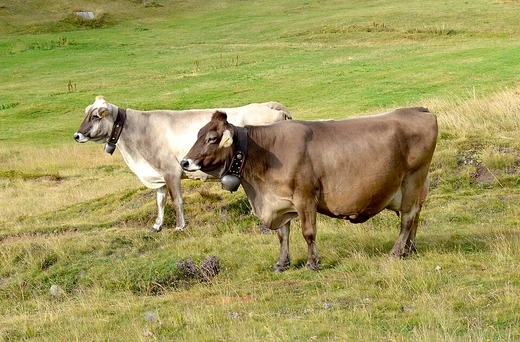
Holstein Friesian
International dairy breed dominant in industrial farming worldwide.

The Holstein Friesian is an international breed or group of breeds of dairy cattle, originating in the region stretching from the Dutch province of North Holland to the German state of Schleswig-Holstein. It is the dominant breed in industrial dairy farming worldwide, found in more than 160 countries, and known by names such as Holstein, Friesian, and Black and White.
- average_milk_yield
- 10,220 kg (22,530 lb) per year
- average_butterfat
- 389 kg (858 lb) (3.7%)
- average_protein
- 359 kg (791 lb) (3.1%)
- mature_cow_weight
- 680–770 kg (1,500–1,700 lb)
- mature_cow_height
- 145–165 cm (57–65 in) at shoulder
Verified Timeline
Lore & Background
The breed's origins trace to near 100 BC, when a displaced group from Hesse migrated with black cattle to the North Sea shores near the Frisii tribe, who kept white and light-colored cattle. Crossbreeding between these groups may have led to the foundation of the Holstein-Friesian. The Frisii bred the same strain of cattle for 2,000 years, though floods in 1282 AD created the Zuiderzee, separating breeders into western and eastern groups. Between the 13th and 16th centuries, the rich polder land of the Netherlands produced enormous quantities of butter and cheese, and historical records describe heavy beef cattle weighing 1,200 to 1,400 kg each.
Reader's Guide
The Holstein Friesian breed has shaped global dairy production, with more than 80% of European dairy production occurring north of the line between Bordeaux and Venice. After 1945, European cattle breeding became regionally confined, leading to specialized dairy and beef lines, whereas North American breeders developed Holsteins solely for dairy. Today, the term 'Holstein' refers to North or South American stock and its use in Europe, while 'Friesian' describes traditional European dual-purpose animals. Crosses are termed Holstein-Friesian. The breed's high milk yield—averaging 10,220 kg per year—and distinctive piebald markings make it instantly recognizable. In the UK, Holstein influence appears in 61% of all dairy cattle, with a notable rise in inbreeding since 1990. The breed's global reach and adaptability have made it central to industrial dairy farming, though its history reflects centuries of selective breeding and regional divergence.
Did You Know?
- A healthy Holstein calf weighs 40 to 50 kg (88 to 110 lb) or more at birth.
- Holsteins average 10,220 kg (22,530 lb) of milk per year, with 389 kg (3.7%) butterfat and 359 kg (3.1%) protein.
- The gestation period for Holsteins is about nine and a half months.
- In the UK, a 2004 study found that 96–98% of Holsteins were inbred to some degree, compared with around 50% in 1990.
- The breed's distinctive blue roan colouring is produced by white hairs mixed with black hairs, giving a bluish tint.
Ancient Roots on the Frisian Coast
Around 100 BC, a displaced group from the Hesse region brought their cattle to the North Sea coast, settling on the island of Batavia between the Rhine, Meuse, and Waal rivers near the Frisii tribe. Historical accounts describe these newcomers' cattle as black, while the indigenous Friesian stock was pure white and light coloured. The crossbreeding between these two groups is widely regarded as the foundation of what would become the Holstein-Friesian. The Frisii people, who favoured pastoral life over military service, paid Rome a tax in ox hides and horns, while the neighbouring Batavii supplied soldiers to the Roman army. For roughly two thousand years the Frisians maintained their cattle strain without deliberate crossbreeding, with only accidental mixing occurring. In 1282, catastrophic floods created the Zuiderzee, physically separating the breeding community into a western group in West Friesland and an eastern one spanning Friesland and Groningen. The region's rich polder soil proved exceptional for grass and dairy, and between the 13th and 16th centuries butter and cheese output was enormous. Breeders consistently aimed to maximize both milk and beef from a single animal, and inbreeding was strictly avoided.
From Dutch Coasts to a Global Herd
The Holstein Friesian's journey from a regional Dutch breed to the world's dominant dairy cattle is closely tied to the expansion of the Americas. As North and South America grew, a surging demand for milk prompted breeders on both continents to import livestock directly from the Netherlands. After approximately 8,800 black-pied German cows had been shipped across the Atlantic, Europe halted dairy animal exports, a decision driven by disease concerns. Today the breed is present in more than 160 countries and goes by numerous names—Holstein, Friesian, Black and White—depending on the region. In northern Europe the animals are primarily valued for milk, while in the south they serve more for meat. After 1945, the development of national infrastructure in Europe increasingly confined cattle breeding to specific regions, creating a practical need to separate dairy and beef roles that had previously been combined in dual-purpose animals. Over 80 percent of European dairy production now occurs north of a line running from Bordeaux to Venice, and more than 60 percent of the continent's cattle are concentrated there. European breeders have since imported specialized dairy Holsteins from the United States to cross with their traditional black-and-white stock, producing what is termed the Holstein-Friesian.
A Coat of Many Colours and a Milk Machine
No two Holstein Friesians look exactly alike, a consequence of the inherent randomness of the piebald gene that governs their markings. The most common pattern is black and white, but red and white variants also appear, and on rare occasions an individual displays both black and red alongside white, a result of the red colour factor. A lesser-known variant, sometimes called blue roan in farm parlance, arises when white hairs intermingle with black ones, giving the animal a faint bluish tint. Beyond their striking appearance, these cattle are renowned for extraordinary dairy output, averaging 10,220 kilograms of milk per year. Of that volume, roughly 3.7 percent is butterfat and 3.1 percent is protein. A healthy calf arrives at 40 to 50 kilograms, and a mature cow typically stands 145 to 165 centimetres at the shoulder while weighing between 680 and 770 kilograms. Heifers are usually bred at 11 to 14 months of age, once they reach about 55 percent of adult weight, with first calving planned between 21 and 24 months. The gestation period runs approximately nine and a half months.
The British Legacy and the Inbreeding Question
The Holstein Friesian left a deep imprint on British cattle before it even carried that name. Up through the 18th century, the British Isles regularly imported Dutch cattle, which became the foundation for several native breeds across England and Scotland. The agricultural writer David Low noted that the Dutch breed was especially well established in Holderness, on the north side of the Humber, extending northward through the Yorkshire plains, and he called them the finest dairy cattle in England. Even as late as 1840, Holderness herds still bore clear traces of their Dutch ancestry. Further north, in the Tees area, farmers brought in continental stock from the Netherlands and the German territories along the Elbe; the resulting mixture became familiarly known as the Dutch or Holstein breed. Yet the breed's modern history in the UK carries a troubling note. A 2004 study published in the Journal of Dairy Science, cited in a Corporate Watch report on intensive farming, found that 96 to 98 percent of UK Holsteins showed some degree of inbreeding, a dramatic rise from roughly 50 percent in 1990, signalling a significant shift in the genetic diversity of the population.
Frequently Asked Questions
What is a Holstein Friesian?
A Holstein Friesian is a dairy cattle breed (or closely related group of breeds) that originated along the coast stretching from North Holland in the Netherlands to Schleswig-Holstein in Germany. It is now the most widely distributed dairy breed on Earth, raised in well over 160 countries.
What are Holstein Friesians most famous for?
They're instantly recognizable by their bold black-and-white piebald markings and are renowned for out-producing nearly every other cattle breed in milk volume. That combination of high yield and distinctive coat has made them the backbone of commercial dairy farming worldwide.
How much milk does a Holstein Friesian cow produce each year?
A typical Holstein Friesian cow yields around 10,220 kg (roughly 22,530 lb) of milk per lactation cycle. That milk averages about 3.7% butterfat and 3.1% protein, translating to approximately 389 kg of fat and 359 kg of protein annually.
How big does a mature Holstein Friesian cow get?
A fully grown Holstein Friesian cow generally weighs between 680 and 770 kg (about 1,500 to 1,700 lb). They are one of the larger dairy types, a frame built to sustain high-volume milk output rather than beef production.
Why are Holstein Friesians so important to the global dairy industry?
Their unmatched milk volume has made them the default breed for large-scale, industrial dairy operations in more than 160 nations. Decades of selective breeding for yield have shaped modern production standards, and their genetics remain central to dairy breeding programs worldwide.
More in Animal Breeds 1-15
Spotted an error? Know more?
This is a living reference — every entry is fact-audited, and reader corrections feed straight into our audit queue. Suggest an edit · See this site's audit record